
Being an medical illustrator, I'm a pretty big fan of any cartoons. I certainly liked the old Looney Tunes, and pretty much grew up on Tom and Jerry. So politically incorrect, so good! The Natural History Museum in Basel, Switzerland has put on an exhibit called Animatus. In it they try to show the skeletons of cartoon characters. I like the picture of Huey, Duey, and Luey. You can check it out here. This came to me via the AMI listserv as so many good things do. In response someone also posted a link to the work of Michael Paulus. See Pikachu exposed.
Aug 25, 2008
Who killed Bugs Bunny?


Aug 5, 2008
Got Bones?
The Bone Room in California seems a legit place to purchase bones: skeletons of all sorts, including humans. Among the many touchy subjects that make up anatomy, this one is, well, touchy. In the eyes of most laws, and suprising to many, it's OK to possess human bones - they're "mineral". It's the movement and procurement of them that makes this touchy.
 This kid is guarding the grave of a family member
Most human skeletons, at least over the last 40-50 years have come from India. They have a fairly facile, slightly european structure, and you'll notice certain things that might indicate poverty or hardship, like anemia and stunting. India is cool, India is straight up and civilized, so what's so bad about Indian skeletons. Ah, it's where they come from in India and how they're procured there that makes this interesting. Over the past 15 years or so, skeletons have become pretty rare commodities. I think there's something like a 4 year wait for one now and you'll pay around 4-5G. That's a lot. This is because, in the past 15 years India has really clamped down on their bone industry. And this is because their bone industry is a bit of a black market. It gets it's bones by grave robbing. This is a little like the 19th century: no corpse is safe. Once dead and buried, the bodies are quickly dug up and, uh, rendered in innocuous little workshops in the middle of residential neighborhoods. Imagine the smell. No wonder India has cracked down in this. It's lucrative. When every western medical school needs skeletons, it simply becomes a supply and demand thing. And it's disturbing. My colleague, an anthropologist, has described the skulls in some collections he has seen as having "pot shine" on their occipital protuberance. This, he explains, is where the back of the skull rubs against the metal pot while being boiled. Nice image, that. Of interest, I got an e-mail from a medical illustrator on the AMI listserv explaining that the first skeleton they had purchased, some years ago, from India for their studio had a bullet hole through the sternum. They promptly returned it.
So. Is there a better way? For the sake of the mental exercise we could DIY some skeletons in our own lab from our own bequeathed bodies. We do have an agreement with the donor families that we can keep certain parts indefinitely, be they rare or really interesting from an educational standpoint. The rest of the body we cremate, in such cases, and return to the family. We don't like doing this and when we do, we try to return as much as we possibly can. Without the skeleton, though, there just wouldn't be much to return, period. And we can't/won't do that. However, for whatever reason, some families don't actually want the cremated remains returned. We could possibly get a skeleton from one of those cadavers. No problems there. Now that brings us back to rendering and that smell. We're in a hospital and people complain enough when they catch a whif of cadaver chemicals outside our lab. Imagine what would happen if we tried to render a cadaver.
In our region of the world, we are governed by the chief coroner. The CC is incredibly powerful in terms of what institutions they can shut down for investigation. The CC also technically "owns" the cadavers we use to teach with in each of the medical schools within our region, and before we use a donated body, we must get written permission from the CC office do so. (I'm not saying if it's a state or shire or province). The CC has a lot on their plate and they don't really want to deal with anatomy departments if they can avoid it. Therefor, the CC's guiding rule for us is: use your best judgement, and don't you dare create a PR nightmare for our office.
...It's the visual, stupid.
And besides, I don't want to be the one who does the rendering.
For an interesting read/listen, NPR did a great piece on the Indian bone trade a while ago. You can listen to it here
Jul 30, 2008
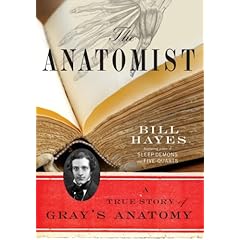
Hayes' Gray's
Bill Hayes talks with Leonard Lopet of National Public Radio WNYC about his book "The Anatomist". The Anatomist attempts to document how Henry Gray came up with his classic anatomy tome. Suprisingly, however, the book details more of the life of Henry VanDyke Carter who did the illustrations that made the book so famous. Seems Gray was secretive and just didn't leave much behind. You should be able to find the link here
Jul 2, 2008
Two great resources today!
One is the paper pelvis. Build your own paper pelvis and you'll finally learn all the details that you keep missing. Click here for instructions.
The second is Massachusetts neuroanatomist Jill Bolt-Taylor's TED talk on having her own stroke. Interesting insights you can watch it here . There's also an NPR interview with her here, complete with a review of her book; "My stroke of insight"
Enjoy
May 28, 2008
Tracking down your images
For anyone who puts images online, say, for a lecture, but is a little wary of it getting out into the bigger world here's a neat thing. Tinyeye scans images for the similarity even if they've cropped, photoshopped, turned into black and white, you name it. Plagiarists beware.
Of course, if you put up anatomy material online and really want to protect it from being released onto the internet, you could use it to make sure it hasn't already.
May 22, 2008
Some pics from both our brainstorming (lego building session) and our trip to the Ontario Science Center to grab some ideas...
 |
| Anatomy Ideas |
Subscribe to:
Comments (Atom)